
Emerging Markets Have A Semiconductor Problem

Author: Chris Wood
The newsflow remains focused on the Middle East, and the Strait of Hormuz, with the continuing lack of a more dramatic market sell-off explained by the fact that investors have learned in recent years to treat such events as buying opportunities.
There has also been a continuing assumption that the conflict will not last long (first days, then weeks and now months).
This dangerously underestimates the resolve of an Iranian regime which faces an existential crisis. Meanwhile, Tehran has done what it said it would do if attacked, namely attack US missile bases in the region regardless of the surrounding collateral damage.
And the damage to these bases has much been greater than first admitted to, as has started to be reported in the Western media (see, for example, Washington Post article: “Iran has hit far more US military assets than reported, satellite images show”, 8 May 2026).
The US-Israel attack on Iran was always highly risky for the American president politically unless there was some pre-agreed deal in place with an anti-regime element in Iran’s security forces.
For now there is no sign of this, though a New York Times article last week revealed there may have been such a plan which backfired (see New York Times article: “Early War Goal Was to Install Hard-Line Former President as Iran’s Leader”, 19 May 2026).
This article gives some insight as to why the Israelis, and the Trump administration, were so confident that they could secure regime change.
This is because they reportedly thought they had secured an “asset” close to the regime similar to the Venezuela precedent. Such hopes have now been dashed.
The surge in energy prices, triggered by the seeming closure of the Strait of Hormuz, will not have been to the liking of the 47th US president.
The Brent crude oil price and European natural gas prices have risen by 36% and 45% respectively since the onset of the Iran war at the end of February even after recent declines on renewed deal hopes.
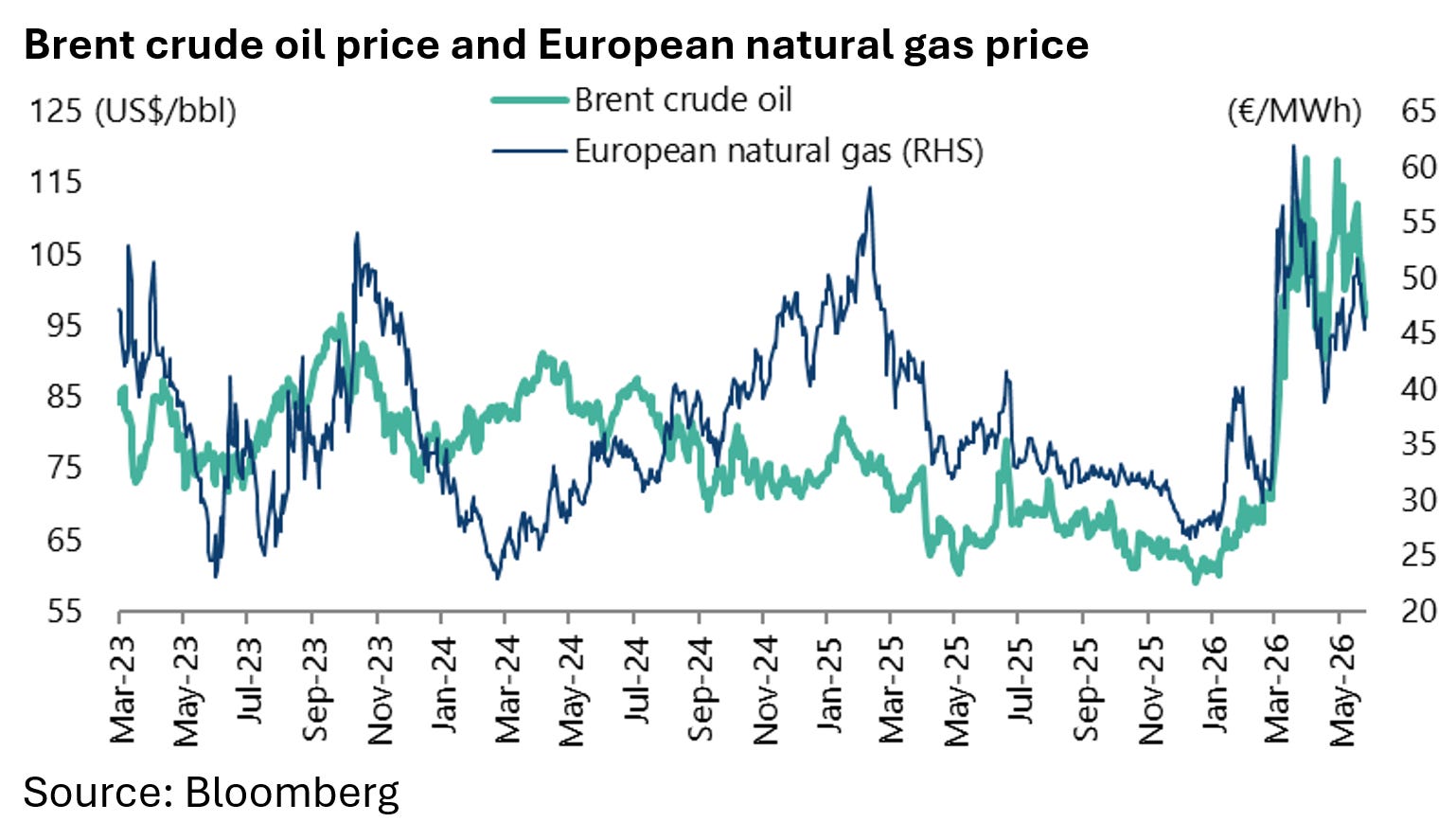
This creates the continuing potential for another Trump U-turn, where the 47th president opts to exit from the conflict on the argument that he has already decapitated the regime.
This, however, will not be to Israel’s liking.
Meanwhile, Trump’s initial claim that the American navy will be able to secure safe passage though the 21 miles narrow Strait has not been credible as reflected in soaring shipping insurance rates.
US Outperforming the World in Q1 and Valuations Remain Reasonable
Moving on from Iran, the renewed momentum in the AI trade since the start of this quarter, combined with the reality that America is much less dependent on imported energy, has led to renewed US outperformance of late.
The MSCI USA has outperformed the MSCI AC World ex-US Index by 7.5% since the end of February.
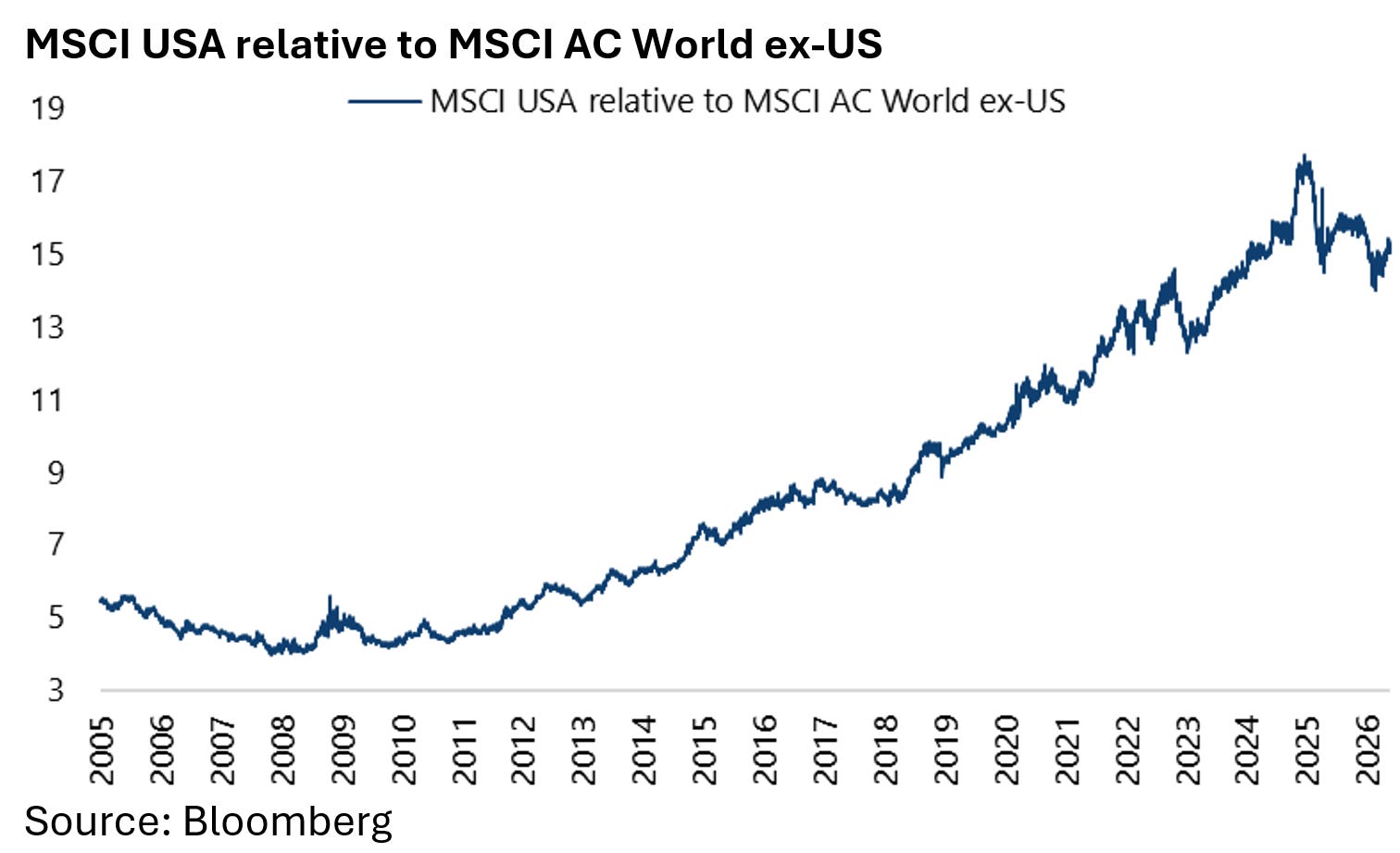
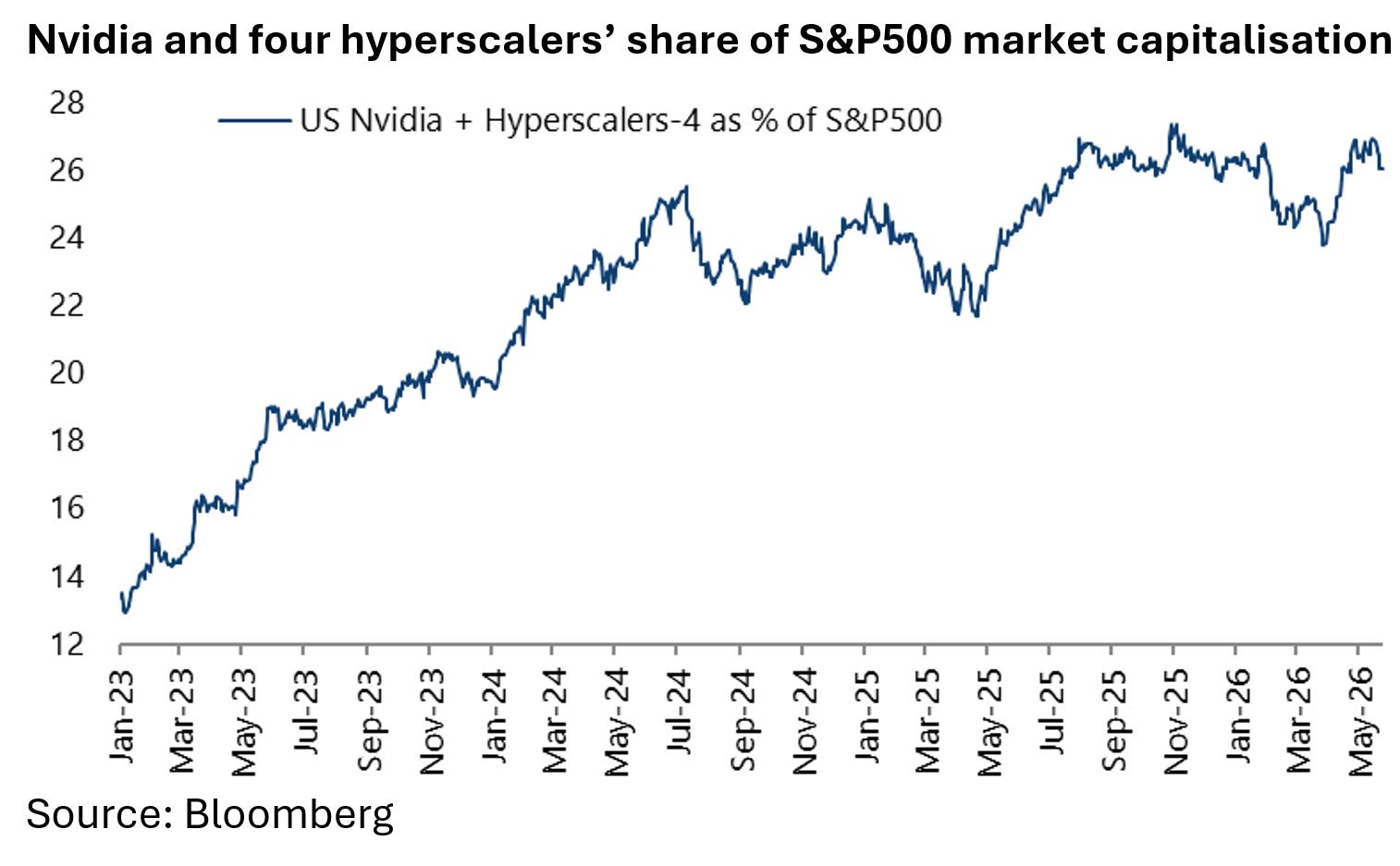
It has also led to renewed concentration in the US stock market in terms of the dominance of Big Tech as defined as Nvidia and the four major hyperscalers.
Still if they are back near the peak percentage of S&P500 market capitalisation, valuations are below recent peaks.
Nvidia and four major hyperscalers’ share of S&P500 market capitalisation rose from 23.8% in late March to 27% in mid-May and is now 26.1%, compared with the peak share of 27.4% at the start of November 2025.
But they are now trading at 22.9x 12-month forward earnings, compared with a recent high of 29.2x in late October 2025 and 33.1x in July 2024.
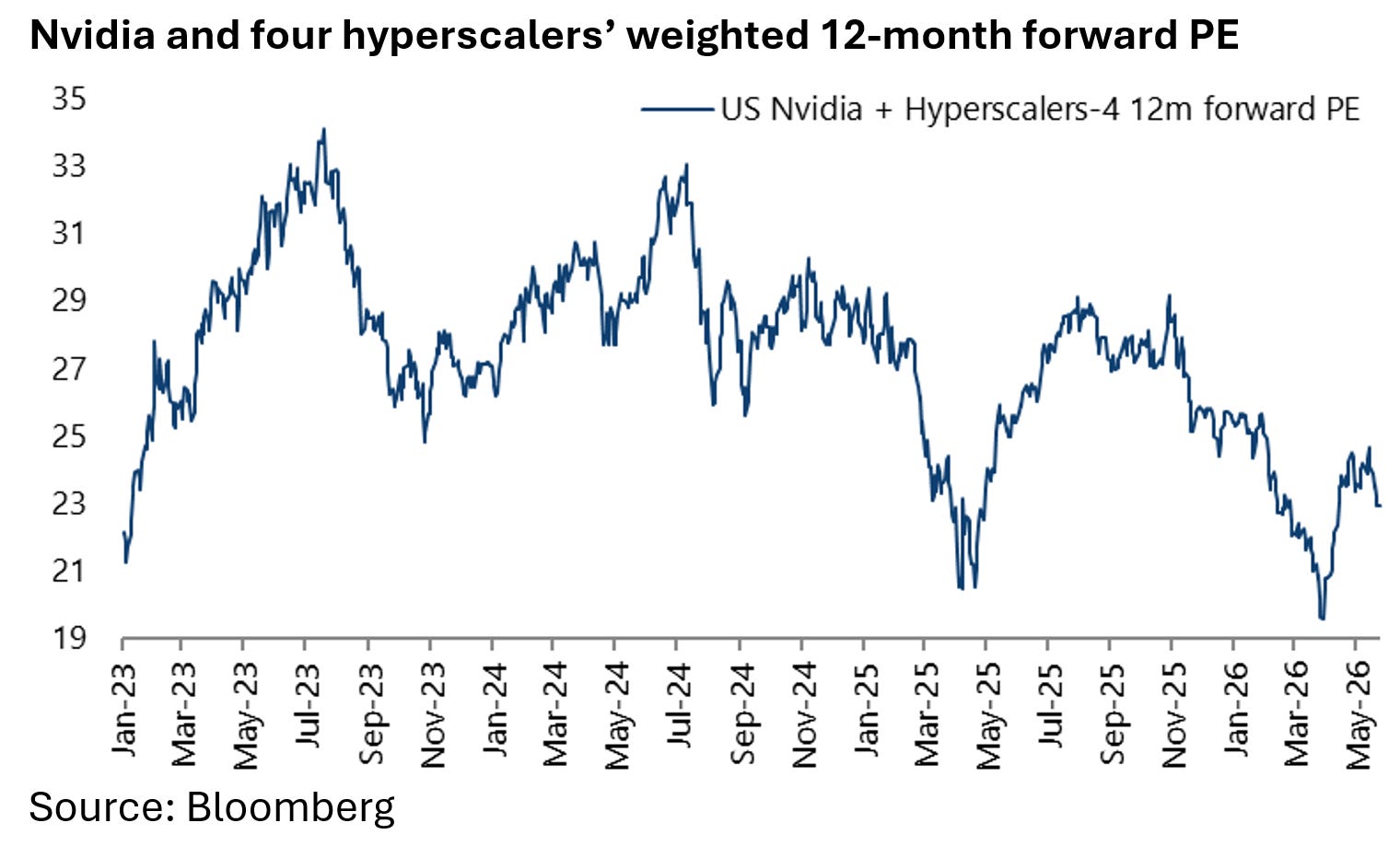
This de-rating reflects growing concerns that hyperscalers’ projected capex this year, at US$680bn, accounts for a projected 92% of their operating cashflow, as recently discussed here (see Why The AI Picks-and-Shovels Boom May Be Peaking, 13 May 2026).
Without the Mag-7, US Stock Markets Would have Looked More like Europe’s.
In the paid portion of this week’s strategy note we look at growing concentration not only in developed markets, but emerging markets as well.
You may be surprised to see what is really driving emerging market outperformance in 2026.